
This page details how nonimmigrants can gain a new status in the United States, through either changing status within the U.S. or through traveling outside the U.S. and re-entering with a new visa. While this information is mostly focused on those changing to F-1 status, there are many similarities for change of status to other statuses (such as F-2).
We expect those interested in Change of Status or Travel & Re-entry to read this page in its entirety. Click on each grey bar below and read carefully.
Simply receiving an I-20 for the new status does not grant you the new status. Either an application with USCIS or international travel and re-entry will be required to gain the new status.
Updates:
- Update Jan 23, 2026: Some USCIS applications have been paused. Please read our announcement on this topic.
- Update Jan 9, 2026: USCIS has announced an increase in Premium Processing fees, including for Change of Status applications that will go into effect for applications filed Mar 1, 2026, and after.
Expand the tabs below to navigate through important information on Change of Status:
About Travel and Re-entry
There is another, sometimes faster and simpler, method of gaining a new status, which is Travel and Re-entry.
- The individual leaves the U.S. with the proper immigration document, gets a visa stamps for their new status from a U.S. consulate or embassy abroad, and then re-enters the U.S. on the right timeline with that visa and immigration document to establish the new status in the U.S.
- This route is not usually advised for those whose country of origin has tense relationships with the U.S., as administrative processing is common and significantly delays the new visa by 4 months or more. If many others from your home country face common visa denials and delays, you might too.
- Canadian/Bahamian Citizens: Please note that Canadian and Bahamian citizens are often exempt from the requirement of having an F-1 visa stamp to re-enter the U.S. in F-1 or F-2 status. But travel and re-entry are still required for them to obtain the new status. You must present your new status’ I-20 to CPB when attempting to re-enter the U.S. and establish the new status type, and you should plan to have your financial documents and admission proof ready in case they ask for it. We hear of many issues with Canadians trying to enter or re-enter the U.S. You should clearly state that you are entering the U.S. as an F-1 for studies or as an F-2 as a dependent of an F-1, whichever applies to your situation. Check the instructions below for travel and re-entry.
About Change of Status
Some non-immigrants in the U.S. (e.g., F-2, F-1, etc.) may want to change to a new, non-immigrant visa status while inside the U.S.
This process is called Change of Status, and for those changing to F-1 status* it is achieved through a specific Change of Status I-20 and submission and approval of Form I-539 with USCIS.
*Those changing to F-2 dependent status will just get an F-2 I-20 under the SEVIS record of their F-1 spouse/parent.
Key considerations of Change of Status:
- Change of Status will not yield a U.S. visa stamp in the passport.
- Change of Status is a process that must be completed while the individual is in the U.S.
- Departure from the U.S. while the application is pending will forfeit the application.
- Change of Status is not a good option for those with any international travel plans while the application is pending.
- The application has two stages:
- Work with ISSS to prepare documents for application, including getting the new Change of Status I-20.
- Submit the Change of Status I-20 with Form I-539 to USCIS and await USCIS decision.
Who is eligible for Change of Status?
- Those who have maintained their non-immigrant status, including F-1, F-2, H-4, L-2, and TN/TD.
- B-1 / B-2 status holders who have been here more than 90 days or who have “prospective student” on their B-1/B-2 visa stamp.
- J-visa status holders who are exempt from the 212(e) two-year home country physical requirement or who have received and maintained a waiver may change to F-1 or F-2 status this way.cha
Who can’t do a Change of Status with Form I-539?
- C, D, K, or M visa holders.
- Those who entered the United States under the terms of the Visa Waiver Program.
- J-visa status holders who are subject to 212(e) two-year home country physical requirement may not change status in the U.S. unless a waiver has been granted. It is the individual’s responsibility to obtain the 212(e) waiver and ISSS cannot guide them on that process.
- Those wishing only to obtain an immigrant status (e.g., Permanent Residence); the Change of Status I-539 Form is only for non-immigrant change of status, so you can’t apply for an immigrant status with that form.
What nonimmigrant status could I change to with an ISSS immigration document?
- F-1 full-time, in-person student at CSU admitted to either a degree program (not a certificate program) or PLACE (CSU’s intensive English program)
- F-2 (spouse or child of someone with F-1 status already)
For those changing to an academic status
Those wishing to change to an F-1 status must first be admitted to their desired program before we can issue the immigration document for them.
Get advised
Make an appointment with an international student advisor to talk through your plan.
While we cannot guarantee your visa and re-entry to the U.S. will be approved, we can help you weigh your options and plan for the process, and we do issue one crucial document you need for the new visa (the Travel & Re-entry, AKA Initial Attendance, I-20).
Check your passport
Make sure it will be valid for the exit and re-entry process
If your passport will expire in the near future, consider taking your international trip as an opportunity to renew your passport from your home country, too.
Get admitted (only for those re-entering as F-1; not applicable for those changing to F-2)
If you will be re-entering the U.S. as an F-1, apply for and be admitted to a Fall or Spring-start, in-person, degree program at CSU, or any term PLACE (our Intensive English Program) allows.
If you will be re-entering the U.S. as an F-2, then you don’t need to apply for a CSU program. In fact, full-time study is prohibited for F-2s. Work of any kind is also prohibited for F-2s in the U.S.
Budget and financial documents
- Prepare financial documents sufficient for estimated expenses which meet our standards for financial documents.
- Estimate your airfare cost.
- Plan which U.S. Consulate / Embassy abroad you will apply for your visa at.
- Not all consulates and embassies accept visa applications from individuals who do not live there.
- For example, if you want to apply for a U.S. visa in Vancouver but you aren’t from Canada, check first to see if they will even accept an application from you before you plan on applying there.
- Prepare $185 for the nonimmigrant visa application processing fee.
- F-1 students must also prepare $350 for the I-901 fee to establish your SEVIS record.
F-1 academic planning
For those getting an F-1 visa, you are prohibited from entering the U.S. in F-1 status any earlier than 30 days before the program start date listed on your I-20.
Plan to have a full course load (12 credits for undergrads, 9 credits for most grad programs, 18 contact hours for PLACE Intensive English students) for every semester in your program except for your final semester.
Consult with your academic department’s curriculum / ‘road map’ and check to see if some required courses are offered infrequently.
Request the I-20
Confirm that you have read this entire page and understand it thoroughly.
Then, request your I-20. You’ll need to provide financial documentation that meet our estimated expenses.
Depending on the time of academic year, it may take up to 7-10 business days for International Programs to process your request once our office receives the complete document set for that form request.
It’s your responsibility to provide sufficient financial and passport documentation at the time of your request.
Leave the U.S. & Get your visa
Leave the U.S. and get your U.S. Visa for the new status at a U.S. Consulate or Embassy abroad.
If you will be travelling and re-entering to become an F-1 upon re-entry, you must also pay the I-901 fee after you get your visa.
Come back to the U.S.
You must enter the U.S. no earlier than 30 days before the program start date on your I-20.
Cover previous U.S. visa stamps in your passport with a simple sticky note (to avoid I-94 mistakes).
At Customs & Immigration, present your passport, new visa stamp, and I-20 and state that you are here for studies (F-1) or as the dependent of an F-1.
Check your I-94 (“Get most recent I-94” tab) immediately, as soon as you pass CBP/Immigration. The I-94 should say you were admitted in F-1 or F-2 status for “D/S” (Duration of Status). Check your name and other info.
If you see any I-94 errors, immediately seek assistance from CBP in that airport for correction.
Notify ISSS when you re-enter the U.S.
New F-2s, please email ISSS when you successfully re-enter in F-2 status! We’ll need to clean up some records.
For new F-1s who were previously F-2 dependents, please email ISSS and/or your former F-1 school when you get the results of your application! We’ll need to clean up some records. These updates aren’t automated. Please don’t forget this!
New F-1s only: Complete IDR & orientation
Immigration Document Review, or IDR, is a requirement for you to activate your new F-1 record. You’ll need to upload your passport, your I-797 approval notice, and the I-94 at the bottom of that I-797. You’ll also need to share your physical address in the U.S.
The online Canvas Course ‘International Student Orientation‘ is for those beginning F-1 or J-1 student status in the U.S., to familiarize you with the requirements and options of your status. You must do the F-1 module. At the end of the F-1 module, you must submit the Certification of Completion eform. Failure to do so will result in a hold being placed on your student account at CSU.
New F-1s only: Begin studies!
Talk to ISSS if you’re not sure what date by which you must be in a full course load. As always, keep copies of all of your immigration documents, including the USCIS receipt & approval notice and your I-20(s).
Begin a full course load and maintain your status.
Some general notes for those changing to F-1 status
About premium processing
Premium Processing is an expensive option to make the process faster. Standard Change of Status cases average 9-13 months. Premium Processing guarantees action on your application within 30 days.
Note, though, that action doesn’t mean approval. Action can be approval, denial, or an RFE (Request for Evidence). In the case of RFE, USCIS pauses the process until you respond with their requested evidence.
About work
Unless otherwise authorized in your current status, work is prohibited until the Change of Status is formally approved. Even with approval, there are restrictions on what kind of work, where, and how much work F-1s can do and when.
Submitting the Change of Status application isn’t an approval. Approval comes via formal documentation saying you’ve been approved and from what date your new status begins.
For those changing to F-1 status without other work authorization present: You must wait until the change of status to F-1 is approved by USCIS and make sure you are within 30 days of the new program start date to engage in F status-specific activities, such as on-campus employment and practical training (if eligible).
About international travel with a pending USCIS application
If you depart the U.S. while your Change of Status application is pending, it will be considered abandoned. You will not receive a refund.
About international travel after Change of Status approval
If you depart the U.S. after your F-1 Change of Status application is approved, you must apply for and receive an F-1 visa stamp* at a U.S. Embassy or consulate before you can return to the U.S.
In other words, Change of Status approval will not result in a visa stamp in your passport, which is required for international re-entry to the U.S.
*Canadians and Bahamians generally do not require an F-1 visa stamp. Canadians especially should read carefully the notes on this page for their nationality, as we’ve heard many stories of Canadians encountering issues for travel, even after they are approved for Change of Status. If you aren’t sure if you need a U.S. visa stamp as a Canadian or Bahamian, please consult a U.S. Consulate or Embassy with jurisdiction over your home country or non-U.S. country of residence.
Planning for Change of Status
Get advised
Make an appointment with an international student advisor to talk through your plan.
Note: you are responsible for your Change of Status application; we cannot guarantee it will be approved by USCIS, but we can help you weigh your options and plan for the process, and we do issue one crucial document you need for the process (the Change of Status I-20).
Check your passport
For those filing with Premium Processing, make sure your passport will be valid for at least 6 months into the future, as always.
For those filing at standard (longer) speed: passport should be valid for the next year and a half, ideally.
If you need to renew your passport, check the Consulate or Embassy of your nationality here in the U.S. for passport renewal processes, or else consider exiting the U.S. and re-entering with a new passport and opting for a new U.S. visa, too, instead of Change of Status.
F-1s only: Get admitted
Prospective F-1s only: apply for and be admitted to a Fall or Spring-starting, in-person, degree program at CSU, or any term that PLACE (our Intensive English Program) allows.
If you won’t be paying for Premium Processing, you should avoid programs which only begin once a year (some graduate programs at CSU only accept new students each Fall semester, for example).
If your Change of Status is still pending after the original program start date has passed, ISSS must defer the start date on your I-20 each semester to keep the SEVIS record from auto-cancelling. Follow up with us each semester no later than one week after classes start to update us on your situation.
You must tell us if and when USCIS takes action on your case. Failure to do so can result in a loss of your new status, even if you were approved.
Prospective F-2 only: If you will changing to F-2 status, then you don’t need to apply for a CSU program. In fact, full-time study is prohibited for F-2s. Work of any kind is also prohibited for F-2s in the U.S.
Budget and financial documents
- Before requesting the I-20, prepare financial documents sufficient for estimated expenses which meet our standards for financial documents.
- After receiving the I-20, F-1 students must also prepare to pay $350 for the I-901 fee to establish your SEVIS record prior to submitting Form I-539 for Change of Status.
- There is also a filing fee required at the time you submit the USCIS Form I-539 for Change of Status.
*Those without dependents joining their status may and should file online. Those with dependents joining their status must file by mail with a paper document set. If filing by mail, budget at least $30 to mail the packet securely with tracking.
If you’ll request Premium Processing, you’ll have to pay the Premium Processing I-907 fee for the Form I-539 in addition to the other fees.
F-1s only: Plan your studies
Plan your studies proactively! Following approval of your new status, you will need to begin studies at the next available term with a full course load of in-person coursework.
Don’t plan to start a degree program in the summer, as far fewer courses are available at all, much less in-person, and a full course load is required in your first term in F-1 status, which is a crushing pace if you start in the summer.
Map out your degree plan using department resources to make sure you will be fully enrolled in every term except your final term and except for thesis/dissertation, provided an RCL is approved.
To plan your studies, reference the curriculum or ‘degree roadmap.’ Ask your department which courses are offered infrequently to avoid problems. Some courses are only offered every spring, for example. See our Enrollment page to learn more about enrollment requirements and online course restrictions of your prospective F-1 status.
Because of how unpredictable the standard timeline is for Change of Status, many prospective graduate students pursuing F-1 status through Change of Status experience hardship due to assistantships requiring a clear start date or departments being inflexible with the start date of you joining the cohort. You may want to talk to your department to see what their rules and policies are, especially if you won’t be paying for Premium Processing.
Request your I-20
Confirm that you have read this entire page and understand it thoroughly.
Then, Request your I-20. You’ll need to provide financial documentation that meet our estimated expenses.
Depending on the time of academic year, it may take up to 7-10 business days for International Programs to process your request once our office receives the complete document set for that form request.
It’s your responsibility to provide sufficient financial and passport documentation at the time of your request.
Gather Application Materials
We strongly encourage that you make another appointment with ISSS to review the materials before you submit the packet to USCIS!
You’d bring the following materials to your appointment (screen-sharing is fine for those who can apply online).
Identity & status documents
- Photo of Passport bio page
- Copy of current visa status, and any other current immigration documents relevant showing that you are currently in lawful non-immigrant status.
- Copy of your entire new status’ I-20. Print it out in color and sign in “Student Attestation” section on page 1 of the form before making a digital scan or photocopy.
- A copy of your most recent I-94
Financial documents
- Pay the I-901 fee and print receipt / save or print the receipt as pdf (you can wait to do this until we’ve reviewed your application packet, if you like–just don’t forget to do it before submitting your application to USCIS!)
• Be prepared to pay the I-539 application fee
• Evidence of financial support
• Former J-1/J-2 visa holders only: Copy of the waiver of the 212(e) Two-Year Foreign Residency Requirement (if you were previously in J status and subject to the requirement), if 212e applied to you (check with ISSS if you have doubts about this).
Optional but recommended: A letter written by you!
- A strong letter can help convince the USCIS adjudicator of your temporary, non-immigrant intent and your financial solvency as well as show that you did not have a pre-conceived intention to study in the U.S., especially for those who came in via B-1/B-2
- We don’t have templates for this, as each person has different circumstances.
- If you want to include a letter, write it before making the second appointment with ISSS for help reviewing your document set, as we will want to help you look over the letter, too.
- For those filing by mail only: we recommend filling out and putting on top the G-1145, E-Notification of Application/Petition Acceptance.
The Change of Status Form
- Form I-539 (see next section)
Apply by submitting USCIS Form I-539 and require documents
Applying Online
Create a USCIS account and then navigate to “File a Form online” after logging in. Then select ‘I-539’ as the type of form you will file from the selection menu. Make it as far in the application as you can without help but DO NOT PAY until you’ve had an ISSS advisor help you look over it.
Payment is the final step, after which you cannot go back and make edits. You can pay with credit or debit card.
Applying by Mail
Use Paper form I-539 and its instructions.
Those whose dependents will change status with them must file by mail.
If you must file by mail, please also prepare your payment method following USCIS payment options for mailed in forms and bring all paper documents to be reviewed by ISSS. We can help you catch clear errors and mistakes.
USCIS will not accept paper checks.
Check your online account and your physical mailbox regularly
You should be on the lookout for new documents or updates.
The first document you should receive is the Receipt Notice. This will be a formal document from USCIS labelled ‘I-797’ and described as “Receipt Notice.” It is a formal notice to you that USCIS has received your application, and it means your application is now pending their review. Ideally, you should both find an electronic, temporary version in your online USCIS account and then the more formal version should come by mail.
Please email any and all I-797 documents to ISSS when you have them.
You should also be on the lookout for Biometrics Appointment demands by USCIS. While rare, we’ve heard from other schools that these may be increasing, especially for Premium Processing applicants. These notices are also I-797 and specify that you must schedule a Biometrics appointment.
Wait
It may take up to 9-13 months for your application to be processed by USCIS unless you file Premium Processing.
If you have not received a decision after 15 months from the date the application was received by USCIS, speak with an ISSS Advisor.
For those who applied online, you can check your case status in your online USCIS account.
For those who applied by mail, you can still look up your case status online with your receipt number.
Notify ISSS when there are updates on your case
New F-1s
You must tell us if and when USCIS takes action on your case. Failure to do so can result in a loss of your new status, even if you were approved. It has happened before.
New F-2s who used to be F-1s
Please email ISSS and/or your former F-1 school when you get the results of your application! We’ll need to clean up some records. These updates aren’t automated. Please don’t forget this!
For those moving into F-1 status from a previous status that restricted work and study
Remember that you can’t have a full course load or work on-campus until after your Change of Status application has been approved. Talk to ISSS if you get confused.
F-1 only; not for F-2: Do IDR & Orientation
Immigration Document Review, or IDR, is a requirement for you to activate your new F-1 record. You’ll need to upload your passport, your I-797 approval notice, and the I-94 at the bottom of that I-797. You’ll also need to share your physical address in the U.S.
The online Canvas Course ‘International Student Orientation‘ is for those beginning F-1 or J-1 student status in the U.S., to familiarize you with the requirements and options of your status. You must do the F-1 module. At the end of the F-1 module, you must submit the Certification of Completion eform. Failure to do so will result in a hold being placed on your student account at CSU.
New F-1s only: Begin studies and maintain your status!
As always, keep copies of all of your immigration documents!
Begin a full course load at the next available term! Talk to ISSS to make sure you know when that’s required for your situation.
Biometrics
It is no longer a default requirement of all Change of Status petitioners to submit a biometrics fee.
But USCIS may still require you to make a Biometrics appointment during the application, decided at USCIS’ discretion on a case-by-case basis.
If USCIS requires a Biometrics appointment from you, USCIS will notify an applicant. The appointment will be scheduled after the applicant receives a biometric services appointment notice and will occur at the USCIS Application Support Center closest to your address.
If you are required to do a Biometrics appointment, your dependents, regardless of age, must each schedule an appointment at the same USCIS Application Support Center as you.
Russian, Iranian, and Chinese citizens
We’ve heard of some Russian, Iranian, and Chinese citizens having longer processing times even when they pay for Premium Processing.
That said, we’ve seen Premium Processing refunds for individuals whose applications are not able to reach a USCIS action within 30 days.
Canadian and Bahamian Citizens
Please note that Canadian and Bahamian citizens are often exempt from the requirement of a having an F-1 visa stamp to re-enter the U.S. in F-1 or F-2 status. If you think you’ll travel and re-enter, consult with the U.S. Embassy or Consulate in your home country to see if you will need an F-1 visa stamp in your passport for your travel to the U.S.
For those visa-exempt students who won’t submit Form I-539, travel and re-entry would be required for them to obtain the new status.
You must present your new status’ I-20 to CBP when attempting to re-enter the U.S. and establish the new status type, and you should plan to have your financial documents and admission proof ready in case they ask for it.
We hear of many issues with Canadians trying to enter or re-enter the U.S. You should clearly state that you are entering the U.S. as an F-1 for studies or as an F-2 as the dependent of an F-1, whichever applies to your situation. Check the instructions for travel and re-entry. If entering by car at a land border, you’ll need to pay for an I-94 application to get one for your new status (which is required)
B-1/B-2 CONSIDERATIONS
Individuals currently in B-1/ B-2 status must first be approved for F-1 status before beginning a program of study. Enrolling in classes while still in B-1/B-2 status will result in a status violation and you will not be eligible to extend your B status or change to F-1 status. There are no exceptions to this regulation.
F-2 CONSIDERATIONS
Individuals currently in F-2 status must first be approved for F-1 status before beginning a full time program of study. Your F-1 spouse/parent must be in the U.S. and in status when you are requesting this change.
H-4 CONSIDERATIONS
H-4 dependents may study in the U.S., but the duration of their stay is dependent upon the H-1B’s period of stay. When H-4 dependent children turn 21, they are no longer considered “children” and are no longer eligible for H-4 status. To remain in the U.S., they must change to another nonimmigrant status. H-4 dependents are not subject to F-1 requirements to pursue a full course of study, but they are not eligible for F-1 benefits such as on-campus employment or practical training. Weigh the benefits carefully before changing status. Individuals in H-4 status who do not already possess an EAD cannot receive an assistantship until F-1 status is approved.
J-1 or J-2 CONSIDERATIONS
Individuals with J-1 or J-2 status with a two-year home residency requirement will not be able to apply for a change of status while in the U.S. You are required to travel outside of the U.S. to obtain an F-1 visa. See USCIS website for more information about changing status within the U.S
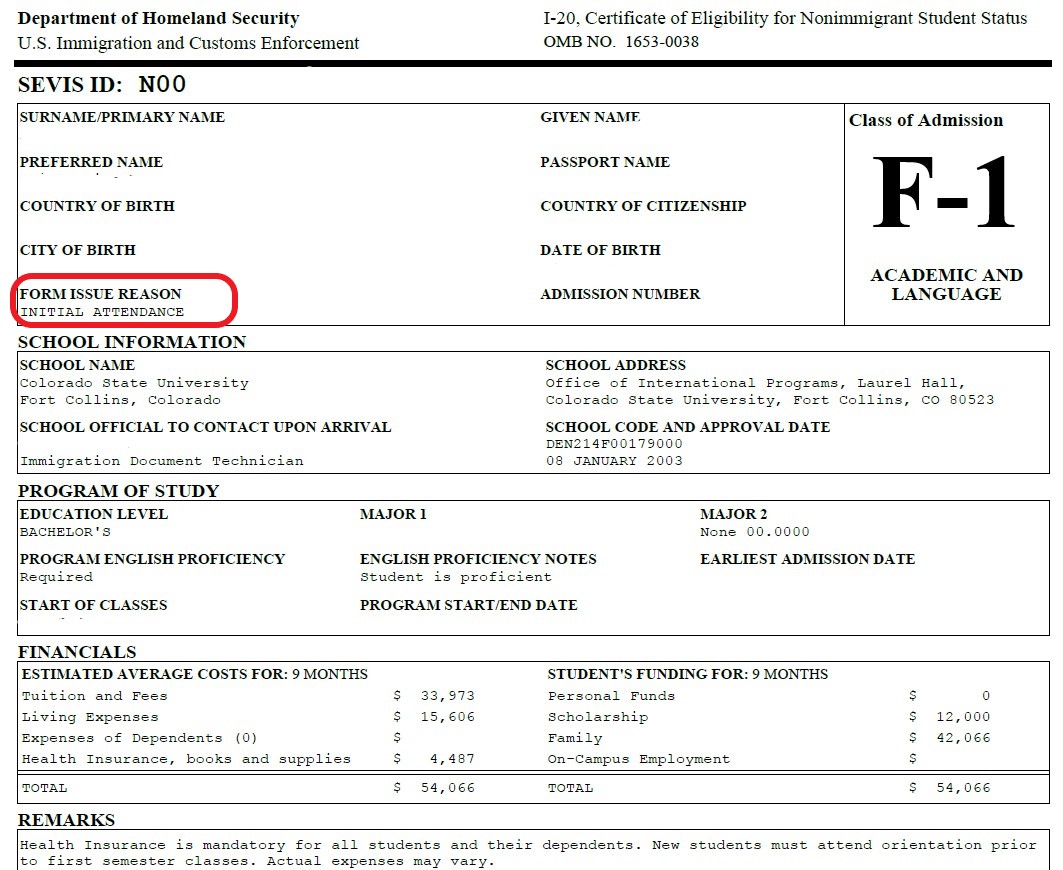
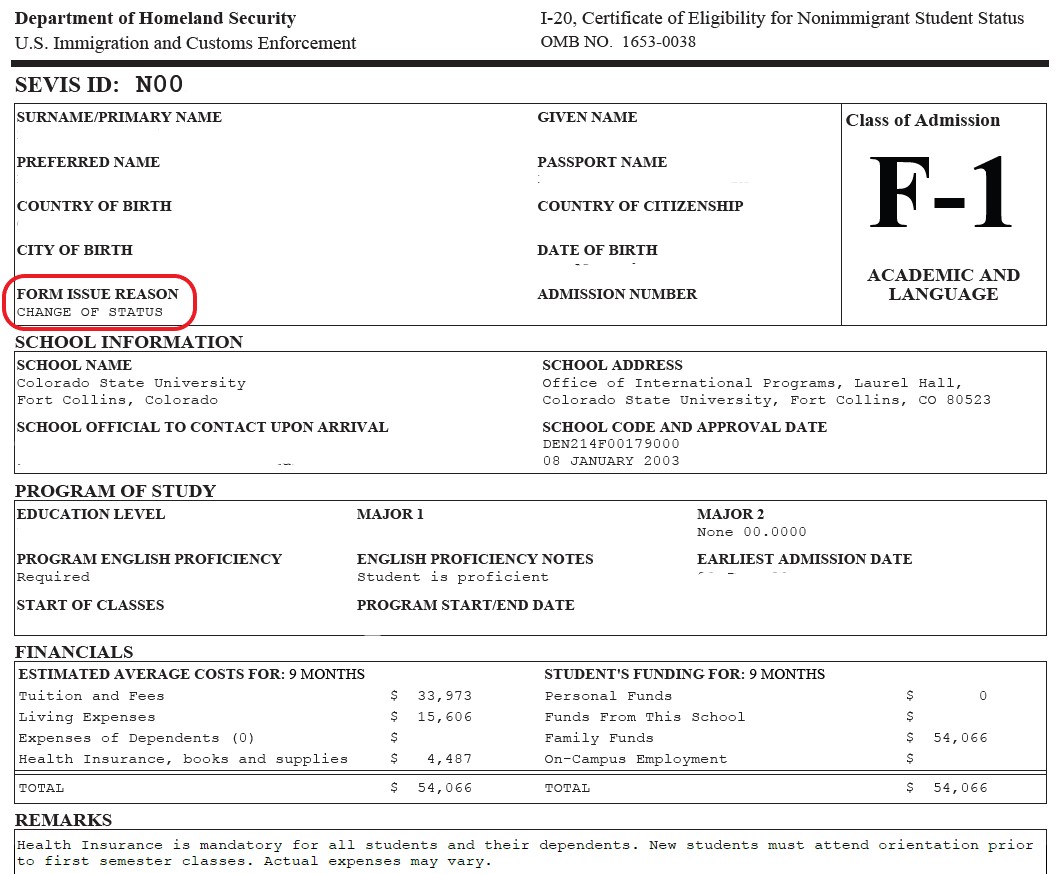
Pictured: F-1 Change of Status I-20 vs. Travel & Re-entry I-20
Those changing to F-1 status
Notice that the Form Issue Reason at the top left is different between the Change of Status F-1 I-20 and the Travel & Re-entry F-1 I-20. You must have the correct type of I-20 for your pathway to the new status.
Those changing to F-2 status within the U.S.
Those who will file a Change of Status application to become an F-2 dependent in the U.S. will actually need an F-2 I-20 from the school that manages the F-1 primary student. This I-20 will not say ‘Change of Status’ unless the F-1 is also changing to F-1 from a different status.